

Med Gemini: Medical AI with Google DeepMind's Cutting-Edge Models
Updated 13 Mar 2026

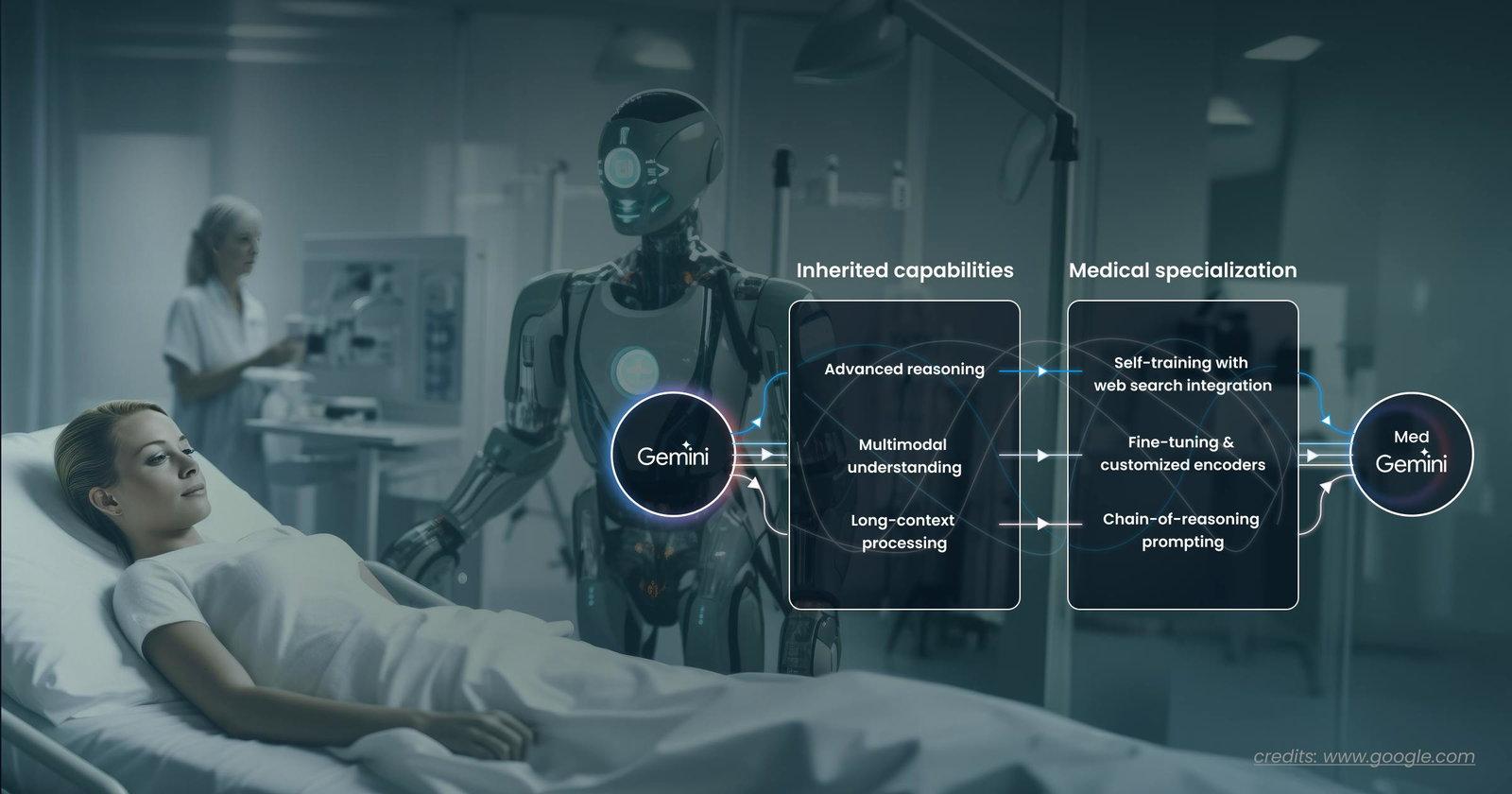
Med-Gemini is a family of multimodal AI models developed by Google Research and Google DeepMind, specifically designed for clinical and medical applications. Built on the Gemini architecture, it processes text, medical images, genomics data, and EHR records to support diagnosis, treatment planning, and clinical decision-making.
Transforming Healthcare with Med Gemini AI
The global healthcare AI market will be worth almost 188 billion US Dollars by 2030.
The prediction from Statista shows the increasing essence of AI in the healthcare domain. AI has revolutionized day-to-day operations across various industries, and the medical field is no exception. To meet the complex needs of the medical sector, Google Research and Google DeepMind have introduced a robust AI model, Med Gemini. It is specifically designed to manage medical data precisely, create accurate medical reports, assist doctors in making better decisions, and more.
Google DeepMind, a subsidiary of Alphabet Inc., is passionate about AI technology, especially in the medical field. They developed an AI system named AlphaFold, which has significantly contributed to addressing the complex medical problem of protein folding. DeepMind also collaborates with multiple healthcare institutes to develop various AI tools, systems, and software for real-time healthcare applications.
Med-Gemini achieved 91.1% accuracy on the MedQA benchmark, outperforming prior models by 4.6 percentage points, making it the highest-performing medical AI model on that test at the time of publication - Analytics Vidya
The above number depicts the increasing potential of Med Gemini. It can analyze large volumes of medical data with remarkable precision, improve personalized medicine by analyzing genetic information, and enhance predictive analytics.
What is Med Gemini?
Med Gemini is a cutting-edge medical AI platform developed by Google DeepMind. Designed to revolutionize the healthcare industry, Med Gemini harnesses advanced AI technology to provide comprehensive solutions for medical diagnosis, treatment planning, and clinical decision support.
Key Takeaways
- Med-Gemini is a clinically-native multimodal AI developed by Google Research and Google DeepMind — trained from the ground up on medical data, not repurposed from a general-purpose model.
- Med Gemini utilizes advanced AI algorithms to analyze extensive patient histories, longitudinal data, and medical literature, enabling nuanced decision-making over prolonged periods for effective disease management and care optimization.
- It scored 91.1% on MedQA (U.S. medical licensing exam benchmark), surpassing GPT-4's ~86% and setting the highest recorded accuracy for a clinical AI model at the time of its 2024 release.
- Med-Gemini can simultaneously interpret X-rays, MRIs, pathology slides, genomic sequences, and EHR text in a single inference pass — directly reducing diagnostic turnaround time across multi-specialty workflows.
- Accessible via Google Cloud's Vertex AI, Med-Gemini enables healthcare teams to build HIPAA-compliant diagnostic tools, clinical summarization engines, and patient risk stratification systems without managing underlying model infrastructure.
- Despite its benchmark performance, Med-Gemini is designed as a clinical decision support tool — its outputs are structured to assist and escalate to human clinicians, aligning with FDA and CE Mark frameworks for AI-assisted medical devices.
How Med-Gemini Works: Core Architecture
Med-Gemini is built on Google's Gemini architecture but fine-tuned specifically for clinical medicine. Unlike general AI models that handle one data type at a time, Med-Gemini processes text, medical images, lab results, genomic data, and patient records together — the same way a physician thinks through a case.
1. Multimodal Input Layer
Med-Gemini ingests X-rays, MRIs, CT scans, pathology slides, clinical notes, genomic sequences, and EHR records in a single unified pass — not as separate tasks.
2. Clinical Fine-Tuning
The base Gemini model was fine-tuned on two purpose-built medical datasets — MedQA-R, which trains step-by-step clinical reasoning, and MedQA-RS, which trains the model to search for evidence when it is uncertain. This is what gives Med-Gemini diagnostic depth beyond pattern recognition.
3. Uncertainty-Guided Search
When Med-Gemini's confidence in an answer falls below a safe threshold, it does not guess — it automatically searches clinical literature, retrieves supporting evidence, and incorporates it into the response. This is the single most important safety feature that separates it from general AI used in healthcare.
4. Long-Context Clinical Reasoning
Med-Gemini was tested on ICU patient records up to 700,000 words long — identifying rare conditions mentioned only once across an entire medical history. This makes it practically useful for real-world cases, not just controlled benchmark tests.
Capabilities of Med Gemini
According to Google's official Med-Gemini research paper, Capabilities of Gemini Models in Medicine (Saab et al., Google DeepMind, 2024), Med-Gemini is a family of highly capable multimodal models specialized for medicine, with the ability to seamlessly use web search and be efficiently tailored to novel medical modalities using custom encoders.
| Key Capabilities | Description |
|---|---|
| Medical imaging analysis | Interprets X-rays, MRIs, CT scans, pathology slides |
| Long-form clinical reasoning | Processes full EHR records for patient summaries |
| Genomic data analysis | Supports personalized medicine via genetic inputs |
| Uncertainty-guided search | Flags low confidence and retrieves supporting evidence |
| Multimodal input | Handles text, image, video, and structured data together |
Med-Gemini vs. General AI Models
| Feature | Med-Gemini | GPT-5.2 | Claude Opus 4.6 |
|---|---|---|---|
| Developer | Google DeepMind | OpenAI | Anthropic |
| Released | 2024 | Late 2025 | Feb 2026 |
| Built For | Clinical medicine | General purpose | General purpose |
| MedQA Accuracy | 91.1% (with uncertainty-guided search) | ~95.84% (general model, untuned) | ~80–83% |
| GPQA Science Benchmark | Not benchmarked | ~91.5% | ~80.8% |
| Clinical Safety Alignment | ✅ Conservative defaults by design | ✅ Highest in 2025 clinical vignette study | ⚠️ Penalized for nuanced over safe choices |
| Medical Imaging (X-ray, MRI, Pathology) | ✅ Purpose-trained on clinical imaging datasets | ⚠️ Multimodal but not medically trained | ⚠️ Multimodal but not medically trained |
| Uncertainty-Guided Search | ✅ Core built-in feature — auto-escalates low-confidence answers | ❌ Not available | ❌ Not available |
| Long EHR Reasoning | ✅ Tested on 200K–700K word clinical records (MIMIC-III) | ⚠️ 400K context; not EHR-optimized | ⚠️ 200K context (1M in beta) |
| Genomics Support | ✅ Trained on genomic data | ❌ | ❌ |
| Hallucination in Medical Contexts | ✅ Actively reduced via uncertainty escalation | ⚠️ 15.8–28.6% in medical contexts | ⚠️ ~16% — more cautious but similar range |
| Racial Bias Robustness | Not publicly tested | ⚠️ Statistically significant accuracy drop under biased inputs | ✅ Among lowest bias sensitivity of frontier models |
| HIPAA-Ready Deployment | ✅ Architecture-level clinical design | ⚠️ Infrastructure-level via Azure | ⚠️ Infrastructure-level via AWS Bedrock |
| API Pricing (per 1M tokens) | Not public | ~$2.50 / $20 | ~$15 / $75 |
| Best Healthcare Use Case | Diagnostics, radiology, pathology, EHR summarization, genomics | Medical research Q&A, documentation drafting | Compliance-heavy clinical writing, long-form analysis |
Google DeepMind Med Gemini healthcare applications
Predictive Analytics
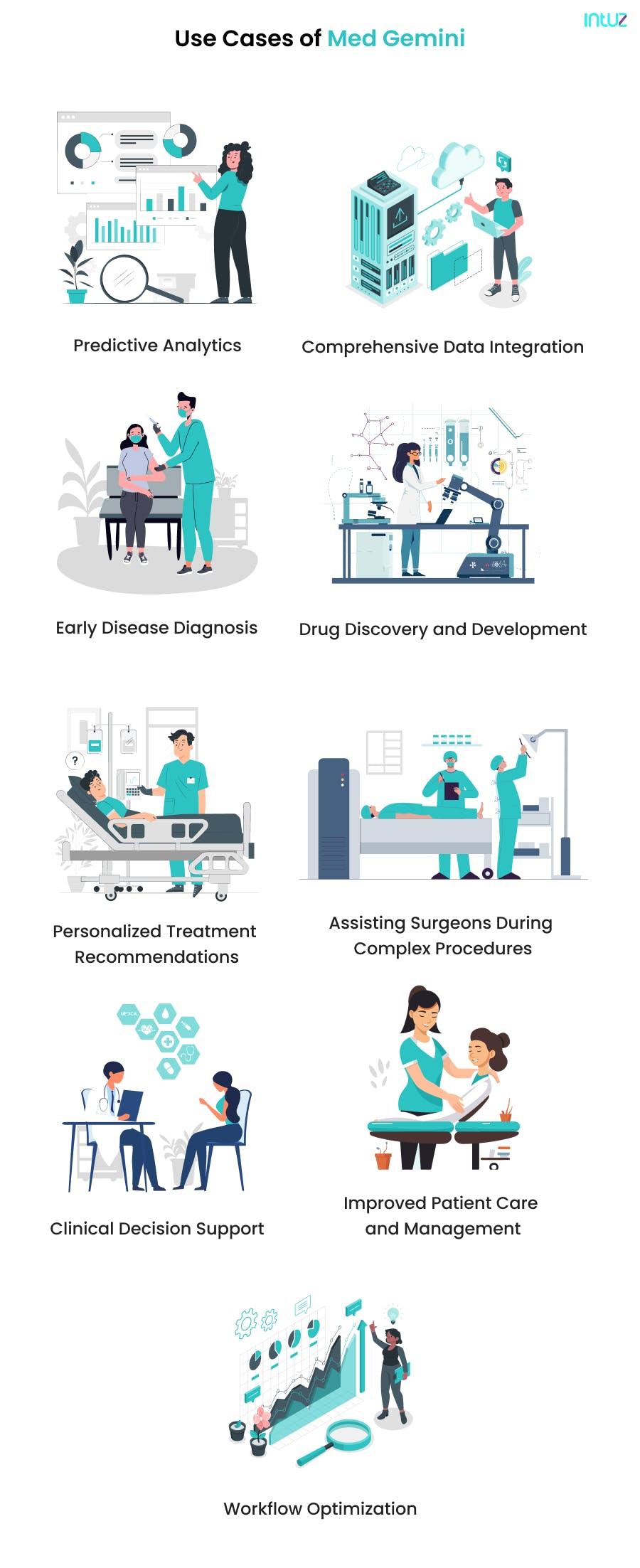
One of Med Gemini's standout features is its predictive analytics capability. By analyzing patient data, electronic health records (EHRs), and other relevant information, Med Gemini can predict disease progression, potential complications, and patient outcomes.
With this prediction, healthcare providers can implement proactive measures that improve patient care and reduce healthcare costs.
Comprehensive Data Integration
Med Gemini integrates data from various sources, including EHRs, medical imaging, laboratory results, and patient-generated health data. Leveraging comprehensive data integration, medical professionals can get a holistic view of a patient's health, enabling more accurate and effective clinical decision-making.
Medical imaging using AI facilitates the healthcare domain to the next level by analyzing complex medical images. According to WifiTalent, "The use of AI in medical imaging globally is projected to reach $19.0 billion by 2025."
Early Disease Diagnosis
Med Gemini leverages deep learning algorithms to analyze medical images such as X-rays and MRIs with superior accuracy. It helps in the early detection of diseases like cancer, heart conditions, and neurological disorders, often identifying abnormalities that might be missed by humans.
The healthcare AI platform can identify patterns in EHRs to uncover hidden risks or potential complications. By analyzing historical and current patient data, it can predict the likelihood of disease progression, enabling early intervention.
Being a leading healthcare AI model, it assists doctors in differential diagnosis by considering a broader range of possibilities and suggesting relevant tests. This comprehensive approach ensures that less obvious conditions are not overlooked, improving diagnostic accuracy.
Med Gemini drug discovery and development using AI
Harnessing the potential of Med Gemini, medical experts can analyze vast datasets of genetic information, protein structures, and disease models to identify potential drug targets. This is particularly valuable in genomics, where understanding the genetic basis of diseases can lead to the development of targeted therapies.
The platform can simulate and predict the effects of new drug candidates, accelerating the discovery process. By modeling how drugs interact with biological systems, the medical AI helps researchers identify promising compounds more efficiently.
Optimizes drug design with the AI model that analyzes potential interactions and side effects at a molecular level. This detailed analysis reduces the risk of adverse effects and improves the safety and efficacy of new medications.
Med Gemini personalized treatment recommendations AI
Med Gemini, a leading healthcare AI, analyzes a patient's medical history, genetic makeup, and current condition to tailor treatment plans. By considering individual variability, the platform ensures patients receive the most effective and personalized care.
It predicts potential drug interactions and suggests safer alternatives, enhancing patient safety. Personalized treatment is particularly useful in managing patients with complex medication regimens.
Med Gemini optimizes treatment dosage and duration based on individual patient responses. This personalized approach maximizes therapeutic benefits while minimizing side effects.
Assisting Surgeons During Complex Procedures
Surgeons can analyze real-time surgical video feeds using Med Gemini to identify anatomical structures and potential complications. It enhances the precision and safety of surgical procedures.
The platform can overlay vital patient data and suggest optimal surgical approaches based on similar cases. This real-time guidance helps surgeons make informed decisions during complex operations.
Med Gemini, an advanced AI in healthcare, provides haptic feedback and guidance to robotic surgical instruments, enhancing precision and minimizing tissue damage. It supports minimally invasive surgery and improves patient outcomes.
It can predict potential blood loss during surgery and suggest strategies for effective blood management, reducing the risk of complications.
Med Gemini clinical decision support systems
Med Gemini provides real-time guidance to healthcare professionals during critical procedures, suggesting optimal approaches based on similar cases. This support enhances procedural accuracy and patient safety.
The platform analyzes a vast amount of medical research to identify the latest treatment options and protocols. This capability ensures that clinicians have access to the most current and evidence-based practices.
Med Gemini can flag potential errors or omissions in treatment plans, improving patient safety and reducing the risk of adverse events.
Improved Patient Care and Management
The AI in healthcare analyzes trends in patient populations to identify areas for preventative care or resource allocation. This capability supports public health initiatives and improves healthcare delivery at the population level.
It empowers patients with better medical information and personalized health recommendations. By providing patients with insights into their health, Med Gemini promotes proactive health management.
The medical AI tool assists with streamlining administrative tasks and optimizing healthcare workflows. This automation reduces the burden on healthcare providers and enhances operational efficiency.
Workflow Optimization
To enhance healthcare efficiency, Med Gemini automates routine administrative tasks such as appointment scheduling, billing, and resource management. By streamlining these processes, the platform allows healthcare providers to focus more on patient care.
Additionally, medical AI helps optimize the allocation of medical resources, ensuring equipment and staff are used efficiently.
Med-Gemini Accuracy: Benchmark Performance
Med-Gemini has set a new performance standard for clinical AI, achieving 91.1% accuracy on the MedQA benchmark — a dataset modeled on the U.S. Medical Licensing Examination (USMLE) — outperforming all prior AI models by 4.6 percentage points at the time of its 2024 release.
| Benchmark | Med-Gemini Score | Prior Best | Improvement |
|---|---|---|---|
| MedQA (USMLE-style) | 91.1% | ~86.5% | +4.6% |
| MultiMedQA | Top-ranked | GPT-4 baseline | Significant margin |
| Medical imaging tasks | State-of-the-art | Prior specialist models | Multi-specialty |
Benefits of Med Gemini for Patients and Healthcare Professionals
Benefits for Patients
- Med Gemini detects diseases like cancer and heart conditions at earlier stages than traditional methods, increasing treatment success rates.
- Tailored therapies based on individual health profiles ensure more effective care with fewer side effects.
- Predicts drug interactions and optimizes medication plans for enhanced treatment safety and effectiveness.
- Empowers patients with clear health insights and real-time monitoring for proactive healthcare management.
Benefits for Healthcare Professionals
- Early disease detection and precise imaging analysis improve diagnostic confidence and patient outcomes.
- Tailored therapies based on comprehensive patient data improve treatment efficacy and patient satisfaction.
- Predicts and prevents adverse drug interactions, ensuring safer medication management.
- Real-time monitoring and data-driven insights support informed decision-making and proactive patient care.
The Future of Medical AI with Med Gemini
The future of medical AI with Med Gemini holds immense promise, driven by continuous advancements in artificial intelligence. As technology evolves, Med Gemini will enhance its integration with healthcare systems, enabling seamless data sharing and collaborative care across medical institutions.
Future iterations of Med Gemini are poised to incorporate cutting-edge AI techniques such as reinforcement learning and federated learning, further improving diagnostic accuracy and personalized treatment recommendations.
The platform's expansion into new medical specialties like pediatrics, geriatrics, and rare diseases will cater to diverse patient demographics, offering specialized care tailored to individual health needs.
Being a popular AI in healthcare, Med Gemini's commitment to ethical AI deployment ensures responsible innovation in healthcare, fostering global impact and accessibility through equitable healthcare solutions.
Are you looking for a custom AI application for your healthcare business?
Conclusion
Google DeepMind's research paper, Capabilities of Gemini Models in Medicine (2024), concludes that while Med-Gemini's results offer compelling evidence of its clinical potential, further rigorous evaluation will be crucial before real-world deployment in this safety-critical domain — making expert implementation guidance essential for any healthcare organization exploring Med-Gemini-powered applications.
Looking ahead, Med Gemini's evolution promises continued innovation driven by AI advancements, integration with healthcare systems, and adherence to ethical standards. It will redefine medical excellence, paving the way for a healthier, interconnected world.
To explore how Med Gemini can enhance diagnostic accuracy and treatment outcomes in your healthcare practice, schedule a consultation with our AI experts at Intuz.
Discover how AI-powered solutions can streamline patient care and receive a personalized roadmap for integrating cutting-edge technology into your medical operations.
AI continues to shape the future of healthcare. Staying informed about Med Gemini’s capabilities can help medical professionals unlock new possibilities in patient care.

Kamal Rupareliya
Co-Founder
Based out of USA, Kamal has 20+ years of experience in the software development industry with a strong track record in product development consulting for Fortune 500 Enterprise clients and Startups in the field of AI, IoT, Web & Mobile Apps, Cloud and more. Kamal overseas the product conceptualization, roadmap and overall strategy based on his experience in USA and Indian market.

Got More Questions?
Let’s us know and our experts will get in touch with you soon
What is Med-Gemini used for?
Is Med-Gemini available for hospitals to use?
What medical data can Med-Gemini analyze?
How accurate is Med-Gemini compared to human doctors?
What is the difference between Med-Gemini and general Gemini?
How does Med-Gemini handle uncertainty in diagnoses?
Can Med-Gemini replace radiologists?
Explore Our AI Resources
Read our articles on Artificial Intelligence and gain deeper insight.

Trusted by


WORK WITH US
Tell us what
cant'fail
We respond within 24 hours with a clear point of view, not a sales pitch.
GET IN TOUCH
or email getstarted@intuz.comResponse within 24 hours — no junior reps
NDA on every engagement — standard, not optional
GDPR · HIPAA · DPA — compliance frameworks are standard, not custom-added
No retainers. No lock-in. Your IP, always.